Great Depression
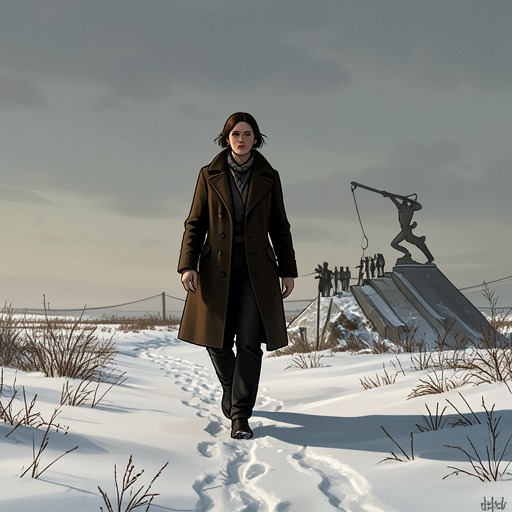
The Master Butchers Singing ClubThe Great Depression is a defining economic pressure in the Waldvogel family’s life in Argus, linking hardship in Germany to precarious work and family decisions in North Dakota. It is not simply a backdrop: the prospect of economic survival governs Fidelis’s migration, the household’s dependence on the butcher shop, and the plan to send most of the boys back to Germany when the business and family finances falter.
Migration and the Work of Starting Over
Fidelis Waldvogel’s move to America in 1922 follows a period of want in Germany after the First World War. He had been forced into a dangerous black market, and the family gathered its remaining resources to pay for his passage. His suitcase held smoked sausage made from a wild boar he had poached with carefully saved bullets; his family’s trinkets and best woolens had helped finance the ticket, while he kept his knives rather than selling them. In New York City, with only a few English words for finding work and traveling west, Fidelis carried the family’s hopes alongside the food meant to sustain him.
The migration is also connected to a small, concrete marvel: a precisely machine-sliced loaf of bread sent to Ludwigsruhe from America. Fidelis examined its fine texture and even crust, learned the name of the distant place from which it had come, and kept that name until it changed from an object of curiosity into a destination. The contrast between the loaf’s mechanical precision and the privation he had known gives the decision to emigrate an economic and imaginative dimension: America appears as a place of possibility, but reaching it requires converting nearly everything the family owns into passage and provisions.
Building a Livelihood in Argus
Fidelis found work immediately with Pete Kozka and also took jobs in nearby towns and at farms, traveling wherever he was summoned. He had no car at first. His skill with sausage, learned from his father, helped increase the Kozkas’ trade. The family rule behind that craft was to use the finest of everything, down to fresh garlic, clean and fresh casings, and the grade of salt. When Fidelis made Swedish sausages for Scandinavian customers, he sought the best local potatoes for the filling. Customers began arriving on Thursdays to buy links straight from the kettle, before smoking, and the new business gave him a path toward bringing Eva and Franz across the ocean.
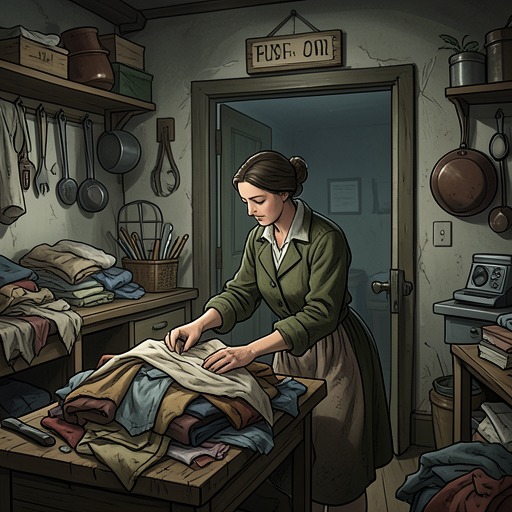
That path depended on austerity as much as on skill. Fidelis lived on sausage ends, bruised fruit, stale cookies, and questionable trimmings; he brewed his own beer and washed his own shirts and aprons. He saved enough to rent a larger place, then used the rest of his savings, together with money from his parents, to bring Eva and Franz to America. Later, with money sent from the share of a family property recovered in Germany, he bought a farmstead in North Dakota and opened his own shop. The Depression and the Waldvogel business are thus joined through a chain of labor, savings, family assets, and transatlantic transfers rather than through a single moment of rescue.
Economic Strain and Household Decisions
The later economic downturn makes the household’s security precarious again. Fidelis sees the collapse around him as devastating as German inflation, which his mother had described in a letter: she had to push wheelbarrows of reichsmarks to the baker to buy bread. He recognizes that he has left one Depression only to encounter another. Though his parents’ recovered property had helped him establish the North Dakota farmstead and shop, the shop’s survival depends on his relentless work, and the family has little freedom to step away from it.
The family’s hardship becomes especially tangible in the plan for Tante to take the boys, except Franz, back to Germany. She expects to raise them with their grandmother for a year or two, until Fidelis can bring them back. The arrangement promises to ease the burden of caring for the boys and allow the shop to flourish. Its causes are left multiple rather than reduced to one: bills, Fidelis’s inability to pay Delphine for her work, Markus’s accident in the hill, Emil’s still-healing pellet-gun injuries, Erich’s fall from a roof, the boys’ dangerous raft ride, and clothes they have outgrown all contribute to the sense that the family cannot manage as it is. The boys’ wrists have grown beyond their sleeves, and Markus is resentful that they still wear short pants. Economic pressure is visible in these ordinary details of care, clothing, safety, and unpaid labor.
The Depression as a Continuing Measure
The Depression remains a measure by which characters assess prosperity and deprivation. On the family’s return north from Chicago, Fidelis and Delphine notice the barns and fields along the road and remark that the region seems to have come through the Depression. Their guarded conversation about the landscape is also a pause in a fraught journey: while Markus sleeps feverishly in the back seat, they check his temperature and encourage him to drink ginger beer, avoiding a difficult explanation until the day’s safe topics give way to silence and suspense.
The novel’s wider chronology complicates any sense that economic recovery ends hardship. During the Second World War, the shop is suddenly overwhelmed with orders, including custom kosher work sought by Jewish synagogues in Minneapolis, yet shortages make daily commerce difficult: gasoline is scarce despite Fidelis’s coveted C sticker, butter is requisitioned, canned goods dwindle, and eggs are powdered for soldiers. The contrast does not erase the earlier Depression; it shows how a family business can move from too little demand to too many orders without gaining dependable access to the goods and resources needed to serve them. Across these episodes, economic crises shape not only income but migration, labor, household arrangements, and the family’s capacity to remain together.